
The Four Chaplains Medal, a Tragically Exclusive Honor
America knows how to honor individuals brave enough to wear her nations uniform. The Navy Cross, the Silver Star, the Bronze Star and the Purple Heart are awarded to service members who have distinguished themselves through heroic and selfless actions worthy of recognition. The pinnacle of these awards is the Congressional Medal of Honor. Medal of Honor recipients belong to a truly exclusive club. In our nations history there have been only 3465 MOH awarded with 618 being granted posthumously and only 19 service men have received the MOH twice. MOH recipients include Sgt Dakota Meyer USMC (Afghanistan), PVT Henry Johnson ARMY (WW1), CPT Ernest Evans USN (WW2) KIA, and Lt Frank Reasoner USMC (Vietnam) KIA. Through their gallant actions under fire, these four heroic men earned their place in the Medal of Honor ranks. However, how does a nation recognize self-sacrificing gallantry which occurs away from the traditional battlefield?
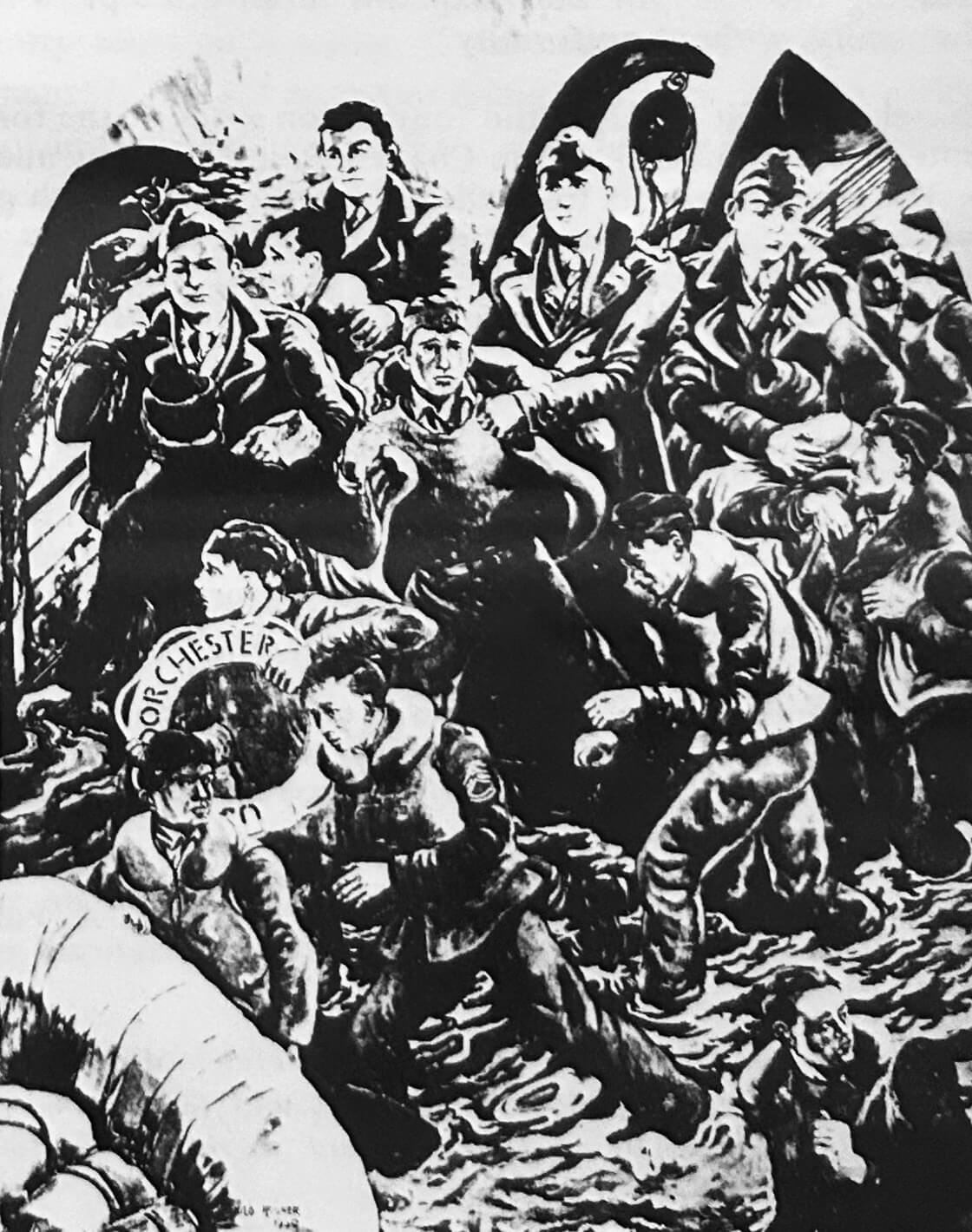
On a bitterly cold February evening in the North Atlantic 1943, a convoy of American troop transport vessels sailed for airbases in Greenland. One of these troop ships was the USAT Dorchester, a recently converted civilian passenger liner. Aboard her were four military chaplains whose duty it was to provide spiritual comfort to the more than 900 servicemen they traveled with. Unfortunately, the Dorchester and her companion vessels were not alone. A German U-boat wolfpack had found the convoy and a large, slow moving troop transport ship made an easy target. U-233 fired a single torpedo which slammed into the Dorchester's engine room. She immediately began taking on water and soon the order to Abandon Ship was issued. Terrified young soldiers crowded the decks, desperate for life jackets. Amid the chaos, four men remained calm. US Army Chaplain Lieutenants John P. Washington, Alexander D. Goode, George L. Fox, and Clarke V. Poling organized the panicked soldiers around the life preserver stations. They distributed life jackets to the young soldiers until there were none left. With the last of the life jackets gone, these four Chaplains then removed their own life preservers and gave those to the men. As the Dorchester sank beneath the waves, soldiers and sailor reported hearing hymns being sang by the four Chaplains. Their bodies were never recovered. World War 2 continued for another two and a half terrible years and the four Chaplain's heroic story became one of many during that troubled time.
In 1957, at their 39th National Convention, the American Legion passed a resolution asking Congress to award the MOH to the four Chaplains. The Legionnaires reasoned that the four Chaplain's actions on that 1943 evening were every bit as heroic as past MOH awardees. But there was a problem. The Congressional Medal of Honor rules are quite specific. In order to be considered, one must be under enemy fire or engaged in enemy action for eligibility. The Chaplains were not under fire during their time of selfless heroism. In fact, after scoring the hit, U-233 quickly sailed away. After much consideration it was determined that no medal or award existed to properly recognize these brave men of faith.
On July 14, 1960, the United States Congress set out to properly recognize US Army Chaplain Lieutenants John P. Washington, Alexander D. Goode, George L. Fox, and Clarke V. Poling. Congressional Act (Public Law 86-656, 74 Stat. 521) authorized the research, construction and issuance of what would be called the Four Chaplains Medal. Building on this momentum, the Secretary of Defense directed the Assistant Secretary of the Army to expedite medal design proposals to be submitted for the President's approval as soon as possible. Mr. Thomas Hudson Jones, of the Institute of Heraldry, was chosen to design the medal. Jones, a veteran of World War 1, was best know for his design work on the Tomb of the Unknown Soldier. The design team got to work. On 5 September 1960, the Institute of Heraldry submitted several designs to the Office of the Quartermaster General for comment, suggestions and hopefully approval. The Quartermaster General's office had only comments and suggestions. This began several months of design submittals by the Institute of Heraldry and suggestions by the Quartermaster General as well as the Commission of Fine Arts who voiced their suggestions during an October 18 meeting. Work continued and on November 28, 1960, the Quartermaster General approved the Four Chaplains Medal design. On January 5, 1961, the approved medals had been cast and were ready for presentation and issuance.
The uniqueness of the Four Chaplains Medal required it be designed for a specific event involving a group of only four men. The graphics on one side the medal display an eagle with raised wings as if taking flight. The other side lists the names of the Chaplains below a Christian cross and Star of David. The medal hangs from a blue bird colored silk ribbon bordered in black.
On January 18, 1961, eighteen years after that fateful February evening, a long overdue ceremony was held at Fort Myer, Virginia. The Secretary of the Army Wilber M. Brucker presented posthumously the Four Chaplains Medal to the families of John P. Washington, Alexander D. Goode, George L. Fox, and Clarke V. Poling. This distinguished military honor exclusively recognized these four United States Military men of God and spoke of courage, commitment to duty, and their unwavering example of service before self. Chaplains John, Alexander, George, and Clarke will be forever known as The Four Chaplains.
Chaplains Motto:
Pro Deo et Patria
For God and Country
Robert W Meyers
Albert J Hamilton Post 7 American Legion Historian
January 30, 2026